The China Kennel Union (CKU) publishes the official Laizhou Hong standard, in Chinese and English, on its former website, in the "native dogs" section (old.cku.org.cn/nativedog/lzreddog.html). The page is undated. It is known to have been online by June 2018 at the latest, and its text did not change between June 2018 and January 2025 (Wayback Machine captures). The often-quoted date of 2017 is plausible but not proven.
This page is not a translation of it. It is our own summary, based on the bilingual text published by the CKU and on Chinese sources (Kepu China, Baidu). Kennels that reproduce the standard do not always copy it faithfully: the "standard" page of the Laizhou Hong Brasil kennel, for example, mixes in elements of the Brazilian standard. For show judging or any question of conformity, only the official CKU text is authoritative.
At a glance#
| What the standard asks for | |
|---|---|
| Origin | Laizhou, Shandong province, China |
| Role | Companion, working dog and guard dog |
| Classification | The standard places it in Group 2 (molossoids) of the FCI nomenclature, but the breed is not recognised by the FCI. At CKU shows, it has been judged in Group 11 (non-FCI breeds) since 2018. In Brazil, the CBKC places it in its Group 11 (breeds it recognises outside the FCI), with a standard dated 6 February 2026 |
| Outline | Large, athletic molosser, slightly longer than tall |
| Coat | Black and red-tan only, short coat |
| Head | Black nose, naturally erect ears, scissor bite |
| Expected temperament | Calm, attached to its family, brave and self-assured |
The standard in one diagram#
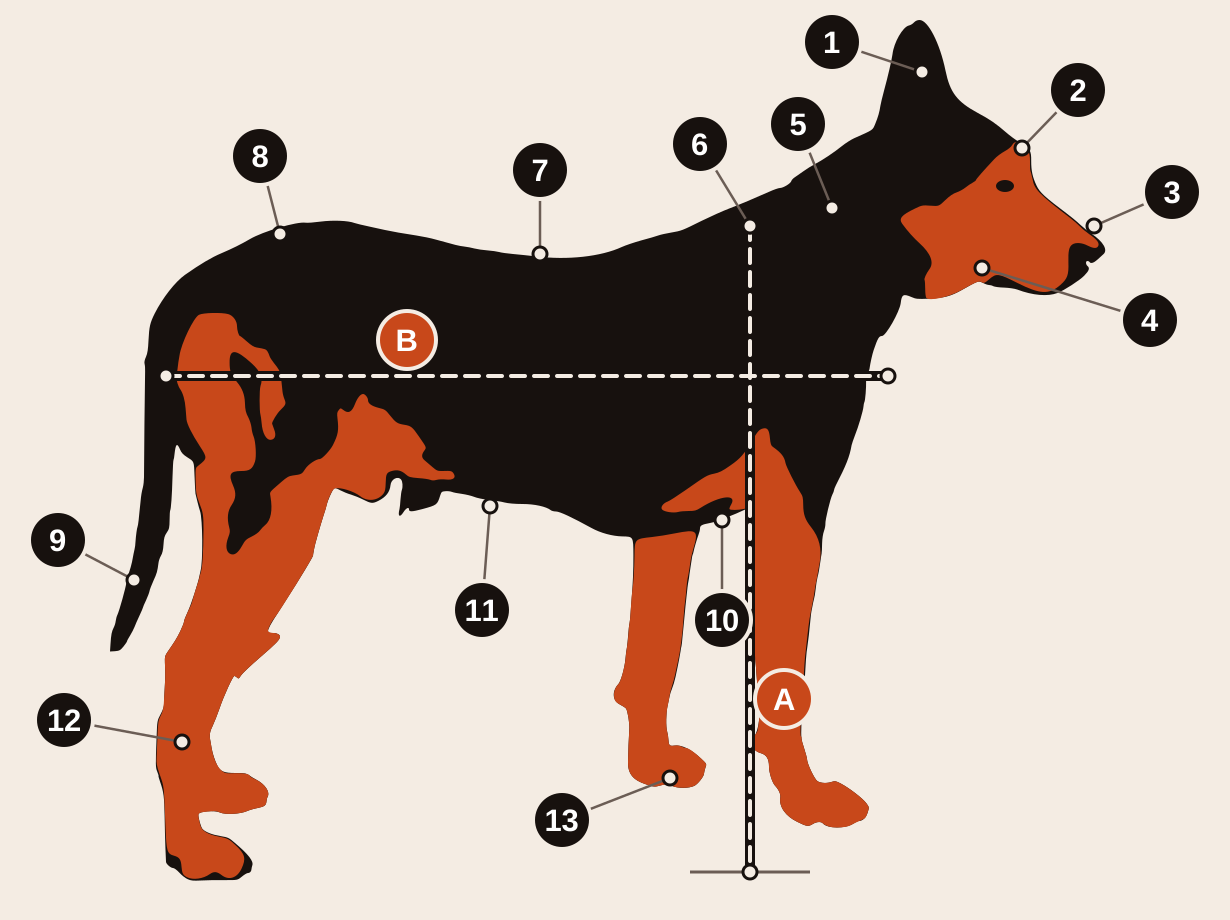
- Ears: naturally erect, set high, never cropped.
- Stop: clearly defined, but not too pronounced.
- Nose: broad and black.
- Tan markings: cheeks, muzzle, above the eyes, throat, chest, legs and under the tail, on a black ground.
- Neck: of good length, muscular, without dewlap.
- Withers: pronounced, especially in males.
- Back: firm, straight and well muscled.
- Croup: broad, of medium length, rounded.
- Tail: of medium length, reaching roughly to the hock.
- Chest: reaches down to the elbows.
- Belly: slightly tucked up.
- Hock: well let down.
- Feet: short, tight and arched, with black nails.
A. Height at the withers: males 64 to 79 cm, females 65 to 70 cm. B. Body length: slightly greater than the height at the withers.
Height and weight#
| Height at the withers (CKU standard) | Indicative weight (not in the standard) | |
|---|---|---|
| Males | 64-79 cm | 40-60 kg |
| Females | 65-70 cm | 35-50 kg |
The CKU standard sets no weight: its "size and weight" section gives only the height at the withers. The weight ranges in the table come from Chinese sources and from kennels.
An oddity of the official text: the minimum for females (65 cm) is higher than the minimum for males (64 cm), and the male range is unusually wide. This is probably a typing error, present in both languages and in every archived version. We quote the figures as they stand.
Other figures are in circulation in Chinese encyclopaedias, with no published measurements: from 55-70 cm (Newton encyclopaedia) to 75-80 cm for 30-45 kg (Baidu, entry "苏联红", "Soviet Red"). The CKU values are the ones used as the reference.
Dogs that have actually been measured sit in the lower part of the official range. The dogs whose measurements are published by the American kennel Alysium stand 63.5 to 73.7 cm and weigh 35 to 52 kg, according to the kennel. One of its females is below the minimum in the standard.
Outline and temperament#
This is a powerful but not heavy dog, well muscled, which should give an impression of strength and presence. The standard defines it as a large molossoid, without excess. Its body is slightly longer than its height at the withers. Males and females are clearly distinct: the male is more solidly built, the female more refined.
The standard describes a calm and friendly dog, very attached to its people, which enjoys working and shows courage and hardness, self-assured, fearless, adaptable and attentive to its social environment. For everyday behaviour, see the Temperament page.
The head#
- Overall: strong, in proportion to the body, without being too massive.
- Skull: strong and long, without a prominent occiput. The forehead is flat and parallel to the nasal bridge.
- Stop: well defined, but not too pronounced.
- Nose: broad and black, with wide nostrils. (The Laizhou Hong Brasil kennel adds that a red or spotted nose is outside the standard.)
- Muzzle: powerful, in proportion to the skull in length, with a straight nasal bridge.
- Lips: tight and lying close to the jaws, so that the mouth closes firmly.
- Gums: darkly pigmented (a requirement of the standard).
- Teeth: broad, powerful jaws, 42 teeth correctly placed and of normal size, scissor bite.
- Cheeks: muscles only slightly defined, never protruding.
- Eyes: almond-shaped, medium-sized, clearly defined at the corners, with an intelligent and eager expression. Colour ranges from light amber to dark brown.
- Ears: naturally erect, never cropped, set high and wide apart, slightly curved on the outer edge, medium to large in size. According to the Laizhou Hong Brasil kennel, they stand up between 3 and 6 months of age. Owners describe young dogs whose ears still flop down when they are happy.
- Tongue: often spotted black or blue-black, as in other Chinese breeds. The standard does not mention it.
The body#
- Neck: of good length, muscular and dry, without dewlap. The skin of the throat is tight, without folds.
- Withers: pronounced in height and length, especially in males. They create the slight slope of the topline from the withers to the croup.
- Back: firm, level and well muscled.
- Croup: broad, of medium length, rounded.
- Chest: reaches down to the elbows, which is half the height at the withers. Well-developed forechest. Ribs well sprung, not barrel-shaped, extending well to the rear.
- Belly: slightly tucked up.
- Tail: medium length, not too thick, tapering evenly towards the tip, reaching roughly to the hock. It is set on in line with the sloping croup. At rest it hangs in a very slight curve. On the move or when excited, it may be raised. Bristly hair on the tail is undesirable. Chinese sources regard a limp, drooping "broom" tail as the sign of a lesser-quality dog.
Limbs and movement#
- Forequarters: legs almost straight seen from every side, vertical and strongly developed. Shoulder well laid back, upper arm of good length and well muscled, elbows close to the body and not turned out, strong wrist. The pastern is strong, straight seen from the front and only slightly sloping seen from the side.
- Hindquarters: seen from behind, the hindquarters look broad and rounded thanks to the well-developed muscles of the pelvis, hips and croup. The legs are straight, parallel and not too close together. The thigh is long, broad and well muscled, with good angulation at the hip. The stifle is strong, the lower thigh of medium length, and the hock and rear pastern well let down.
- Dewclaws: the standard asks for the hind dewclaws to be removed, except in countries where the law forbids it. Chinese enthusiasts accept that they may be kept.
- Feet: short, tight and well arched, with short black nails, on both front and hind feet.
- Movement: the standard gives it particular importance, for working ability as much as for appearance. It is elastic, elegant, agile, free and ground-covering. The forelegs reach out as far as possible and the hindquarters provide far-reaching, elastic drive. The foreleg on one side and the hind leg on the other side move forward at the same time. The back, ligaments and joints stay stable. Pacing (both legs on the same side moving together) is a fault.
The coat#
- Skin: tight-fitting all over the body.
- Hair: short, dense, smooth, glossy and harsh, with an undercoat according to the Chinese version of the standard.
- Colour: black base with bright, clearly defined red-tan markings on the cheeks, muzzle, throat, chest, legs, above the eyes and under the tail. Chinese sources describe a tan ranging from vermilion to deep reddish-brown, and favour a rich red.
- Puppies: according to the Laizhou Hong Brasil kennel, they are born with a reddish coat that darkens as they grow, ending up black and tan.
- Wikipedia lists, without a source, red, brown or black-saddled coats. Chinese sources mainly report all-black dogs. The CKU standard accepts only black and red-tan.
What is penalised#
Faults: any departure from the standard is a fault, penalised according to its degree and its effect on the dog's health and welfare. The standard lists:
| Part | Fault (CKU standard) |
|---|---|
| Coat and hair | Tan too light or poorly defined, smudged markings, mask too dark, large black patch on the legs, chest markings barely visible or too large. Hair long, soft, curly or dull, thin coat, bald patches. White marks on the forechest or white feet: highly undesirable |
| Type | Lack of sexual dimorphism or of substance, dog too light, too heavy or too leggy, weak bone |
| Head | Too heavy, narrow, short or long. Too much or too little stop, ram nose, poor slope of the skull, weak lower jaw, round or slit eyes, eyes too open or too deep-set, heavy cheeks, loose flews, ears set too low |
| Topline | Back not straight, swayed or roached. Chest not deep or broad enough, tail set too high, too much or too little tuck-up |
| Limbs | Too little or too much angulation, loose elbows, feet too close together or too far apart, cow hocks, open or soft feet, crooked toes, pale nails |
| Movement | Unbalanced movement, in particular pacing |
The standard does not list non-erect ears. Chinese sources nevertheless regard soft or drooping ears as the sign of a "degenerate" or crossbred dog.
Disqualifying faults: a dog showing any of these faults cannot be confirmed or placed.
| Area | Disqualifying fault |
|---|---|
| Behaviour | Aggression or excessive fearfulness |
| Jaw | Lower jaw too short or too long, level (edge-to-edge) bite |
| Teeth | Missing teeth |
| Males | Testicles absent or undescended (both must be normal and fully descended) |
| General | Any obvious physical or behavioural abnormality |
Breeding: the standard ends by stating that only functionally and clinically healthy dogs, with conformation typical of the breed, should be used for breeding.
The two versions of the official text#
The standard is bilingual, but the Chinese and English texts do not say quite the same thing. The Chinese version is sometimes the more consistent one: it describes a "double coat, short, dense, smooth, glossy and harsh", whereas the English contains the word "dull", which nevertheless appears among the faults.
It also shows traces of an unfinished document: one term in the list of faults left as "XXX" (the English has "spread locks"), an empty "skin" section, "42 canine teeth" instead of 42 teeth, and a hock described as "well angulated" where the English says "well let down". On these points, we follow the more consistent reading of the two texts.
What Chinese enthusiasts look for#
What follows comes from texts by Chinese breeders and enthusiasts (a 2017 "k9" article, the Baidu and 360 encyclopaedias, an enthusiasts' forum). It is not the standard.
These texts describe a dog somewhat different from the CKU one: wedge-shaped head and square muzzle, a slightly pendulous upper lip covering the lower one (other Chinese texts reject this), loose skin on the neck, a frequent "double back" (a muscular groove along the spine), large ears set rather close together, whereas the standard wants them wide apart. The ideal tail is whip-like or sabre-shaped.
For these authors, a curled or bushy tail and a yellowish or whitish coat are disqualifying. White on the chest or on all four feet is disqualifying for some and a mere fault for others. An enthusiasts' forum considers 65-75 cm enough for a male and 60-65 cm for a female, and criticises Chinese buyers' race for ever bigger dogs.