In brief#
In China, the Laizhou Hong (莱州红犬, Láizhōu hóng quǎn) is still first and foremost a rural guard dog. It is sold at dog markets and on agricultural platforms, usually for a few hundred to 2,500 yuan. No source gives a figure for its population or its breeders. Chinese web pages copy one another heavily: a fact that rests on a single source is attributed to that source.
Where is it found?#
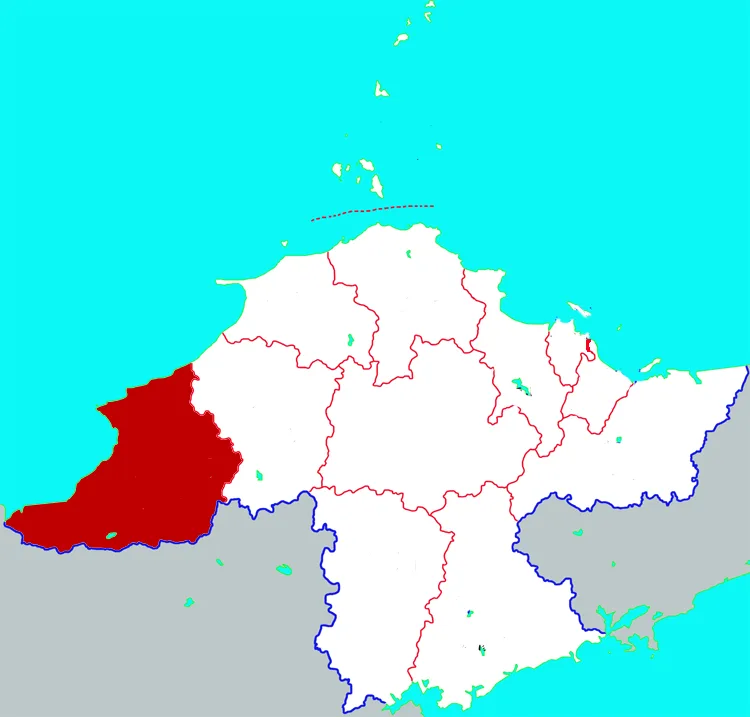
According to the CKU (China Kennel Union), the breed is "widespread in Laizhou, Longkou, Yantai and throughout the country". The online encyclopaedia Newton describes it as relatively common in Shandong, Shanxi, Henan and Anhui.
Recent listings point the same way. On 28 September 2026, the agricultural trading platform 惠农网 (Huìnóng wǎng) showed 21 Laizhou Hong listings. Most came from Anhui (Suzhou) and Shandong (Heze, Jining, Jinan), none from Laizhou. All of them pair the breed's name with "Soviet Red" (苏联红, Sūlián hóng).
According to a 2020 Sohu article, the breed is rare at dog markets (狗市, gǒushì), and those who sell it are mostly dealers who specialise in breeding it.
The Zhuqiao market, in the past. In the early 1990s, the town of Zhuqiao (Laizhou), the breed's birthplace, is said to have been the largest dog market in China. A 1994 article in an agricultural magazine is titled "The country's largest dog market is in Zhuqiao". The 360 and Newton encyclopaedias still name Zhuqiao as the breed's "largest breeding site" (最大繁殖地), with no date or figure.
How much does it cost?#
| Period | Price reported | Source | Note |
|---|---|---|---|
| 1980s or 1990s, depending on the text | Over 10,000 yuan for a top-quality stud dog | Baidu Baike, Chinese article from 2017 | Figure repeated everywhere, never sourced |
| December 2018 | 1,500 yuan or more for a dog of good type, unsaleable at 700 yuan if ear setting has failed | Sina, report from a dog market | Location not given |
| January 2020 | 2,000 yuan for a 6 to 7-month-old youngster, bought back for at least 3,000 yuan | Sohu, report from a dog market | Only example of a buy-back price |
| May 2020 | 500 to 2,000 yuan | 爱宠网 (Àichǒng wǎng) website | Price described as highly volatile |
| April 2023 | 2,000 yuan | Title of a Bilibili video | Title only |
| September 2026 | 299 to 1,400 yuan, mostly 300 to 600 | 21 listings on 惠农网 | Asking prices, no guarantee |
As a rough guide, at an indicative rate of about 8 yuan to 1 euro, 300 yuan is about €40, 2,500 yuan about €310 and 10,000 yuan about €1,250. This conversion is approximate. For the golden age, it says nothing about the real value of the sum: according to a 2017 Sina article, 10,000 yuan in the 1980s would today be worth "surely more than 100,000".
The 2020 Sohu article and the 爱宠网 website both describe prices inflated by dealers' speculation (炒作, chǎozuò). In the same article, a dealer promises to buy back young dogs sold for 2,000 yuan for at least 3,000 yuan if they are returned to him after more than three months.
Headlines announcing "over 10,000 yuan" today rest only on golden-age prices. At the other extreme, in a case heard in Henan, a buyer claimed that the Laizhou Hong was worth only "a few dozen yuan". This is one party's allegation, not an observed price.
What is it used for?#
Guard dog. This is the best-attested use, both in the CKU standard and in Chinese texts. Listings sell it to "guard the house and yard" (看家护院, kānjiā hùyuàn). The encyclopaedias describe it as suited to guarding factories and homes.
Badger hunting. CKU articles from 2017 mention hunting. A 2017 Chinese article and Baidu Baike describe it as a good hunter of hog badgers (猪獾, zhūhuān) and small wild animals. The amateur breeders' text quoted below calls it "the terminator of wild boars and badgers". No source describes an actual practice, and the CKU standard does not mention hunting.
Companion dog. According to a 2020 Baidu article, it is "gradually finding its place" among companion dogs. Use by the police, asserted by some encyclopaedias, is not confirmed by any police source.
The dark side#
Meat dog. The Laizhou Hong has also been bred for its meat, as early as the 1990s. In 1995, an agricultural magazine published a "Method for raising the Laizhou Hong as a meat dog". The official chronicle of the city of Xintai (Shandong) for 1986-2000 lists it among the main meat-dog breeds. According to the Baidu and 360 encyclopaedias, in an undated text, it is still the main meat-dog breed in some regions of northern and central China, where farms cross it with other breeds. In 2026, 惠农网 still files its listings under "live livestock" (活畜, huóchù).
Dog fighting. Videos of dog fights involving dogs presented as Laizhou Hong circulate on Chinese platforms. This site condemns such fights and does not link to these videos.
Market practices#
Glued ears. The Laizhou Hong's ears stand up naturally. Yet according to a 2018 Sina report, dealers glue or tape puppies' ears to make them stand, and the price collapses if this fails. In 2024, the title of a seller's video advertises a "before and after" contrast in setting a puppy's ears. For Chinese sources, soft ears in an adult are a sign of crossbreeding.
Puppies sold under other names. "Soviet Red" is a trade label. Dealers applied it to any dog with a black back, red belly, short coat and erect ears, including retired police Kunming Dogs and crossbreeds. According to Baidu and 360, puppies of a "meat version" are sold as genuine Laizhou Hong. Baidu Baike also states that from 2010 onwards some breeders brought in other breeds to pass their dogs off as Laizhou Hong.
Dobermann or Laizhou Hong? In 2020 and 2022, two buyers suspected that a puppy they had paid for as a Dobermann was a Laizhou Hong, and the breed was never established (see The Laizhou Hong and the law in China). The court involved noted that the pet trade in China still lacks standards.
Few identified breeders#
No source gives a number of breeders or CKU registrations. Sellers visible online present themselves as "breeding bases" (养殖基地, yǎngzhí jīdì) or "specialist sellers" (卖犬专业户), and some offer several guard breeds.
The only Chinese kennel identified by name is Royal Blood Kennel, in Shantou (Guangdong), far from Shandong. According to its own website, the only source on this point, it breeds the Cane Corso, the Laizhou Hong and the Dogo Argentino, and its Laizhou Hong line is registered with CKU-NB, the CKU's native-breed registry. No registration number is published. The kennel sells worldwide (see Breeders worldwide).
What Chinese breeders say#
The main text from the amateur breeders' world is by the administrator of the Baidu Tieba (贴吧) forum "莱州红吧", devoted to the breed, and was published on Sohu in 2017. The encyclopaedias claim that the breed produces uniform offspring. This text says the opposite: there is no perfect dog, and "almost every Laizhou is different". It advises keeping breeding dogs that consistently produce good puppies, even if they are less handsome.
It criticises the race for size. Buyers first ask "how tall is it, how heavy is it", without looking at type, coat or character. According to the author, this fashion has produced "pig mastiffs" (猪獒) in the Tibetan Mastiff, "Shaanxi version" Rottweilers and "donkey Langqing" (驴青), and it also affects the Laizhou Hong.
The same text names stud dogs well known in these circles: Aobama ("Obama"), Tiepi ("Tin Plate"), Luhu ("Land Rover") and Dahu ("Big Tiger"). These are dogs' names, with no kennel, pedigree or date attached.
How to read a Chinese page about the breed#
Copies are not sources. Most Chinese pages come down to three or four copied texts: the "苏联红" entry in the 360 encyclopaedia, the "莱州红" entry in Baidu Baike and a "中国红犬" profile reused by several sites. The same article sometimes appears under two different accounts. In 2020, a Baidu article was even republished with "莱州红" replaced by "苏联红", right down to the titles of the references it cites. Ten identical pages count as one source.
The "科普中国" label guarantees nothing. The Baidu Baike entries "苏联红" and "莱州红" carry the label "authority certification 科普中国" (Kēpǔ Zhōngguó, "Popular Science China"). Yet they contain the Latin name of a frog, a gestation period of 18 to 25 days and contradictory figures.
Advice copied from another breed. The buying advice in the "苏联红" entry (360, Baidu, Newton) talks about a lama consulting the puppy's horoscope. It clearly comes from a text about the Tibetan Mastiff.
Watch the units. Chinese texts often count in jin (斤, 500 g). Baidu's "puppy of over 75 kg at six months" probably comes from confusing jin with kilograms.
What matters. A date, an identifiable author, a cited source. CKU texts, official documents and dated articles come before encyclopaedias.
Sources#
- 惠农网, "莱州红犬" listings (viewed on 28 September 2026)
- Sina, report from a dog market (2018)
- Sohu, a dealer sells Laizhou Hong for 2,000 yuan (2020)
- 爱宠网, origin and character of the Laizhou Hong (2020)
- Sohu, text by the administrator of the 莱州红吧 forum (2017)
- Baidu Baike, 莱州红 and 苏联红
- Baidu, article on Zhuqiao (2020)
- Chronicle of the city of Xintai 1986-2000, livestock breeds
- People's Court of Shangcheng district (Henan), February 2023
- Shandong Shangbao news item republished by The Paper, June 2020
- Royal Blood Kennel, kennel presentation