The breed

History of the breed

Story

The story of an encounter#
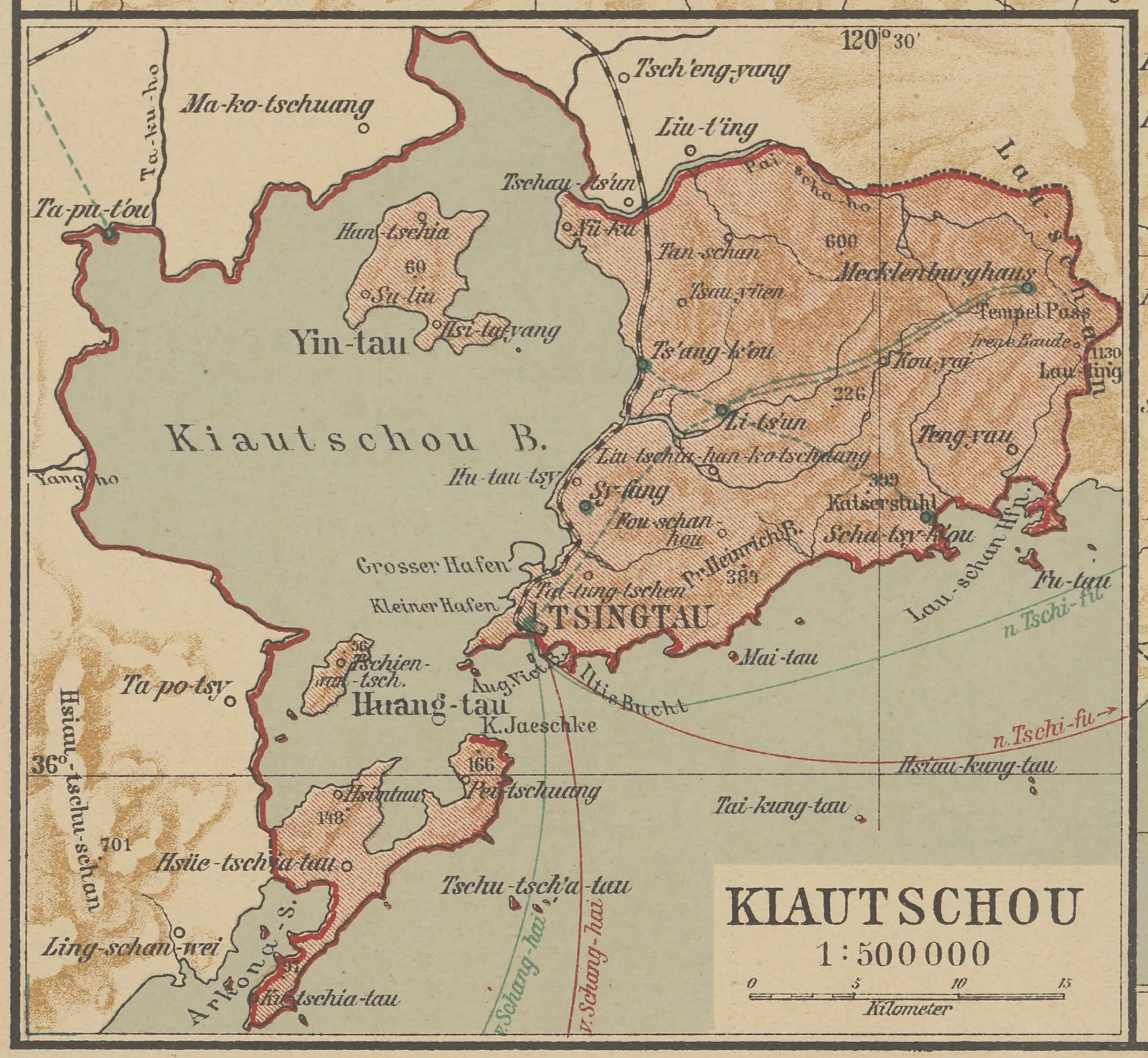
German map of Kiautschou Bay in 1910
The German leased territory of Kiautschou (Jiaozhou) and the city of Tsingtau (Qingdao), from a 1910 German colonial atlas. Map: unknown author, public domain, Wikimedia Commons

In 1898, the German Empire obtained from the Qing dynasty a ninety-nine-year lease on Jiaozhou Bay, at the southern tip of the Shandong peninsula. Soldiers, engineers, missionaries and settlers made their homes around the port of Qingdao. According to the CKU standard, they arrived with their working dogs: German Shepherds, Rottweilers and Great Danes.

These European dogs are said to have found a land that already had dogs of its own. The villages of Shandong were home to hardy farm dogs and a fine and fast hunting sighthound, the Shandong sighthound. Over the years, the standard says, crosses became more and more common, sometimes by chance and sometimes by design. Farmers are said to have found in them a valuable balance: the mass, strength and guarding instinct of the German molossers, combined with the stamina, speed and resilience of the local dogs. This story is repeated everywhere, often word for word, but the pages that tell it all copy the CKU standard, and no document from the period confirms it.

Zhuqiao, the cradle of the breed#
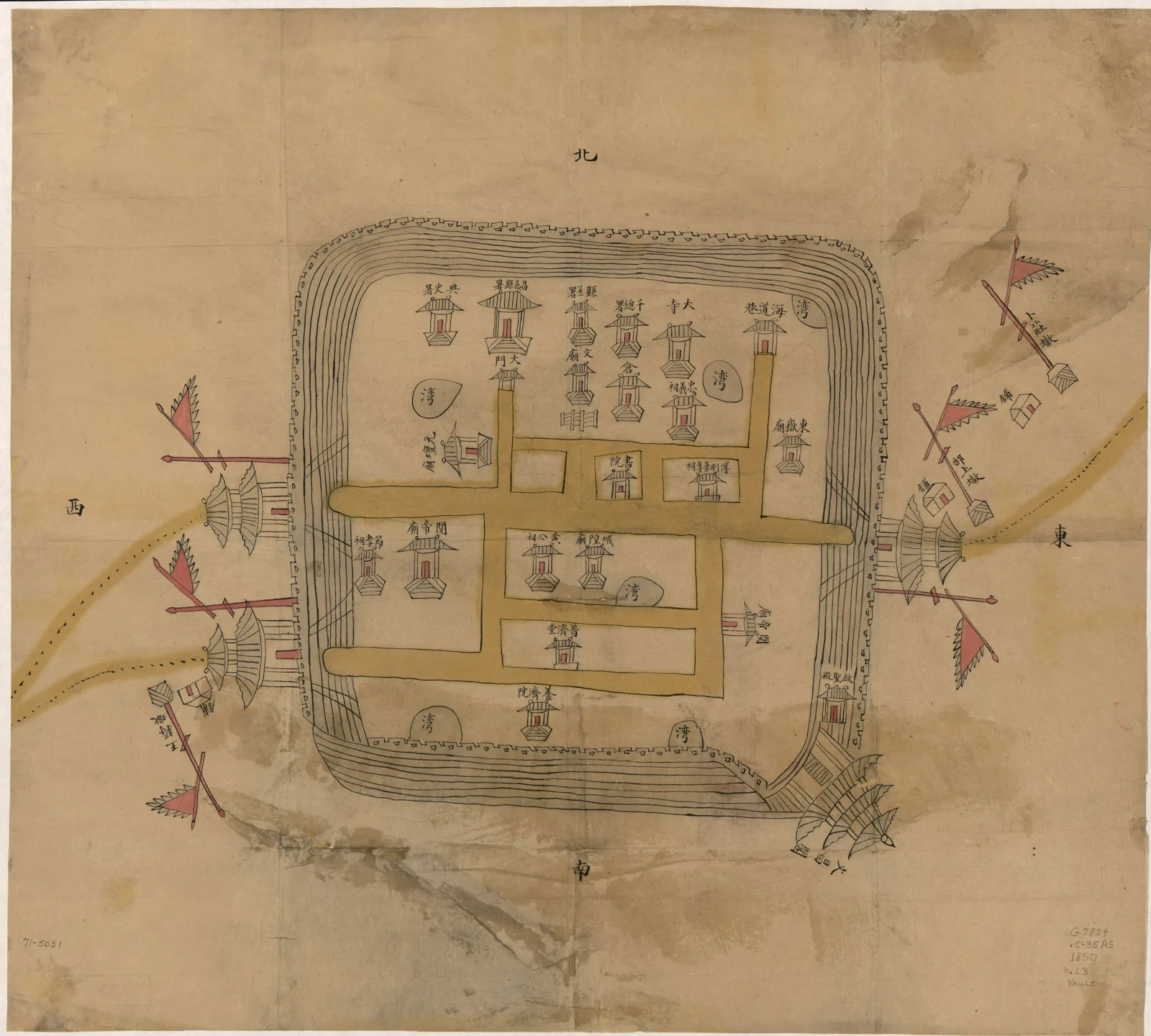
Old pictorial map of the city of Laizhou
Pictorial map of the city of Laizhou (Laizhou prefecture and Changyi county), first half of the 19th century. Library of Congress. Map: unknown author, public domain, Wikimedia Commons

The type we recognise today took shape much later, in the 1970s, around the town of Zhuqiao, part of the city of Laizhou on the northern coast of the peninsula. Chinese sources tell the story of a big black dog weighing around sixty-five kilos, with erect ears and a square muzzle, nicknamed "Da Lao Hei", the big old black one. Every Laizhou Hong is said to descend from him. The tale is probably as much local legend as genealogy, but it captures what matters most: the breed is the patient work of village breeders who, for decades, selected the dogs that best guarded their yards and their livestock. The oldest dated written records are Chinese articles from 1994, which already describe it as a "famous dog".

They named it after its town and its colour. Laizhou for the place. Hong, 红, for red: that deep, almost coppery red that marks the cheeks, muzzle, chest and legs against a black coat. Old descriptions waver between a long, fine muzzle and a square, massive one.

The golden age and the false "Soviet Red"#

In the 1980s and 1990s, the Laizhou Hong became a star. It could be found on farms and in warehouses, in the homes of local dignitaries who wanted a prestige dog and, according to Chinese encyclopaedias, with some local police forces. Dealers came from all over the country to Zhuqiao, which in the early 1990s was reputed to be the largest dog market in China, and a good male could reportedly sell for more than ten thousand yuan, a small fortune at the time.

This was when a stubborn misunderstanding was born. To charge more, some dealers renamed the breed "Sulian Hong", the Soviet Red, as if the dog had come from abroad. Yet it has no connection whatsoever with the USSR. The nickname caught on in everyday speech and ended up describing any black dog with a red belly and upright ears. Even today, many websites present the "Soviet Red" as a separate breed. It is the same dog, even though the nickname was also used to sell other black and tan dogs.

The decline#

The craze faded as quickly as it had arrived. From the 1990s onwards, the German Shepherd, and then every fashionable Western breed, flooded the Chinese market. The Laizhou Hong was now just a "local dog". Uncontrolled crossbreeding spread and produced smaller, thinner dogs with yellowish markings and drooping ears. As early as the mid-1990s, farming magazines were also presenting it as a meat dog that fattened quickly. Chinese sources report that some dogs ended up being sold by weight. With no breeders' association and no national standard, purebred dogs became so scarce that the breed came close to disappearing.

The revival#

The turnaround came from Chinese enthusiasts. Later, Chinese canine specialists proposed a single name, "mountain red dog". In 2017, the China Kennel Union registered the breed and held its first shows for it. In December, in Weifang, in its home province of Shandong, it held the first specialty show devoted to the Laizhou Hong. Its official standard, under the name Laizhou Hong, describes an athletic molossoid, black with clean tan markings, calm and devoted to its family. That same year, according to British breeders, the first dogs left China for the United Kingdom.

In 2019, the breed was shown at the World Dog Show in Shanghai, among the breeds that the Fédération Cynologique Internationale (FCI) does not yet recognise. It then reached the United States, Serbia, Australia and Brazil. A few years later, according to her kennel, an American female earned the breed's first IGP working titles, proof that its working instinct had survived a turbulent history.

A paradox: in the years following its recognition by the CKU, several Chinese cities, including Qingdao, put it on their lists of "fierce" dogs banned in urban areas (see The Laizhou Hong and the law in China).

Today in France#

The Laizhou Hong arrived in France in the 2020s. A handful of kennels have taken it up. It remains very rare, and it is recognised neither by the FCI nor by the Société Centrale Canine (French Kennel Club), which means it cannot be registered in the LOF (French stud book). Its future outside China depends on a small number of founding dogs, which is why health testing and transparent breeding matter so much.

Born, according to the most widespread story, of the meeting between German dogs and the dogs of Shandong, shaped by village breeders, praised to the skies and then almost forgotten, the red dog of Laizhou is only just beginning its story beyond China.

Timeline

Key dates

  1. 1898 The German lease of Jiaozhou

    Germany obtains a 99-year lease on Jiaozhou Bay and Qingdao. According to the CKU standard, German Shepherds, Rottweilers and Great Danes then arrive in Shandong and cross with local dogs, including the Shandong sighthound. No document from the period confirms this.

  2. 1970s The breed is fixed in Zhuqiao

    The black and tan type is fixed around Laizhou. The founding story tells of a large black dog of 65 kg, “Da Lao Hei”, from which all Laizhou Hongs are said to descend.

  3. 1980–1990 Golden age and “Soviet Red”

    Peak popularity in China: guarding, prestige. Dealers rename the breed “Soviet Red” (苏联红) to pass it off as a foreign breed and sell it for more.

  4. 1990–2000 Decline

    The fashion for German Shepherds, then for Western breeds, costs the breed its market. Uncontrolled crossbreeding puts purebred dogs at risk.

  5. Uncertain date A single name

    According to Chinese encyclopaedias, unnamed experts propose the name “Chinese Mountain Red Dog” (中国山红犬) to unify the breed’s names. Some pages date this to 2012, others only say “in recent years”.

  6. 2017 The breed joins the CKU

    The China Kennel Union (CKU) registers and shows the breed (Shanghai in October, Weifang in December). Its undated standard is online by June 2018 at the latest. First imports into the United Kingdom, according to British breeders.

  7. December 2017 First specialty show in Weifang

    On 15 December 2017, the CKU holds its first specialty show for the Laizhou Hong, with an assessment of the dogs, in Weifang (Shandong).

  8. September 2018 A group for non-FCI breeds

    From 1 September 2018, CKU shows include a group 11, reserved for breeds not recognised by the FCI and created to encourage native Chinese breeds, including the Laizhou Hong.

  9. 2019 World Dog Show in Shanghai

    Shown in group 11 (non-FCI breeds), with four other native Chinese breeds not recognised by the FCI.

  10. 2019–2026 City bans in China

    From April 2019, at least eleven Chinese cities, mostly in Hebei and Shandong, class the breed among “fierce” dogs banned in urban areas. No known national law targets it.

  11. 2021 A British registry

    Creation of the Chinese Red Dog Registry, a private pedigree registry for the breed outside China.

  12. 2023 First American litter

    First litter born in the United States (9 September 2023), according to the Alysium Red Dogs kennel.

  13. April 2024 Chinese Red Dog Aid UK

    Incorporation in the United Kingdom (22 April 2024) of Chinese Red Dog Aid UK, a not-for-profit association that informs owners and helps rehome dogs of the breed.

  14. 2024–2026 First working titles

    According to the Alysium kennel, the female Rieka becomes the first Laizhou Hong to earn the IGP1, then the IGP2 title (titles not verified in an official database).

  15. 2026 Brazil and France

    The CBKC (Brazil) admits the breed to its group 11 (6 February 2026). A few breeders in France.

  16. June 2026 Bologna show

    Two Laizhou Hong are entered at the ENCI (Italy) international show in Bologna.

1. The German Shandong story (1898-1914)#

In 1898, the German Empire obtained from the Qing dynasty a 99-year lease on Jiaozhou Bay and the city of Qingdao (Shandong peninsula). The German presence ended in 1914.

The CKU standard links the birth of the breed to this period. Germans who settled in the region are said to have brought their working dogs with them: the German Shepherd, Rottweiler and Great Dane (some sources add the Dobermann, without confirmation). According to the CKU standard, these dogs were crossed with Shandong dogs:

  • the Shandong sighthound (山东细犬, Shandong Xigou, "Shandong Xian Hound" in the CKU standard),
  • local village and farm dogs.

This story is repeated, often word for word, by most pages in Chinese, English and French. But these pages copy one another: its only real source is the text of the CKU standard, online by June 2018 at the latest. No document from the period confirms it, and Qingdao lies about 200 km from Laizhou. No dated source links Laizhou to the German presence, and the same colonial story is used elsewhere to explain the origin of other Chinese "wolf-dogs", such as the black wolf-dog. The oldest dated written records of the breed are Chinese articles from 1994, which already describe it as a "famous dog" (名犬). Chinese sources place its development in Zhuqiao, by local breeders, between the 1970s and the early 1990s (see below). The two stories are not incompatible, but neither is proven.

A 2020 Chinese article even admits that the history of the Laizhou Hong is short. It makes up for this with the very long history of one of its ancestors, the Shandong sighthound.

2. Establishment of the breed (1970s)#

Chinese sources (Baidu Baike, Kepu China) date the true establishment of the breed to the 1970s, in the town of Zhuqiao (朱桥镇), in the city of Laizhou. The founding story tells of a large black dog of about 65 kg, with erect ears and a square muzzle, nicknamed "Da Lao Hei" (大老黑, "the big old black one"), which appeared among local breeders. All Laizhou Hong are said to descend from this dog. Several Chinese texts themselves call this story a legend with no scientific basis: a single dog cannot create a breed.

Baidu Baike and a Chinese agricultural database give a simpler version, the closest to the dated sources: in the 1970s, the people of Zhuqiao crossed local dogs with the "Japanese" Langqing and the German Shepherd. The genetic make-up cited by other Chinese sources, broader than that given by Western sources, includes:

  • Great Dane,
  • "flat-backed" German Shepherd (old working lines),
  • Rottweiler,
  • Korean "Dosa" or "Tosa" (韩国杜莎犬), depending on the transcription, sometimes cited as the source of the red colour,
  • Shandong sighthound (Shandong Xigou),
  • Japanese Langqing (日本狼青, "Japanese Wolf Blue Dog"), descended from military dogs left behind by the Japanese army, which China still used, among many others, when it relaunched its police dogs in 1979,
  • local dogs, and the Kunming dog (a Chinese police dog), cited by a French website, a 2018 Chinese article and the Alysium kennel, but absent from the CKU standard.

The Newton online encyclopaedia also mentions trial crosses with the Rottweiler ("羅山紅犬"), which could explain why the Rottweiler appears in some lists of ancestors.

A minority theory, reported by the 2020 Chinese article, which says it needs checking, places the origin in Xi'an: the dog would only have taken the name of Laizhou because it was very common there.

Some French sources sum it up as: "breed created in 1889, confirmed in the 1970s" (probably 1898, the date of the German lease, with the digits swapped).

3. Golden age (1980s-1990s)#

The Laizhou Hong became extremely popular in China as a guard dog for farms and businesses and a prestige companion. According to Chinese encyclopaedias, some local police forces also used it. Dealers from all over the country competed for dogs. Zhuqiao is said to have been the largest dog market in China at the time: a 1994 magazine article is titled "The country's largest dog market is in Zhuqiao". According to the 2020 Chinese article, dogs were brought there from Linyi and Laoshan (Shandong), Handan (Hebei) and Dalian (Liaoning), a mixing that may have helped to shape the breed. At the height of its popularity (the 1980s or the 1990s, depending on the text), a good stud dog is said to have sold for more than 10,000 yuan, a figure repeated everywhere but never sourced.

It was then that dealers renamed the breed "Soviet Red" (苏联红) to suggest a foreign origin and push up prices. The name caught on in everyday speech, and eventually any black dog with a red belly, short coat and erect ears came to be called a "Soviet Red", which diluted the breed.

4. Decline (1990s-2000s)#

The mass arrival of the German Shepherd, followed by fashionable Western breeds (Golden Retriever, Husky, Poodle...), cost the Laizhou Hong its market. It was now seen as a "mere local dog". The Laizhou Hong was also raised for its meat, and not only because of its decline. In 1995, a Chinese farming magazine already ran an article on raising the "Laizhou Hong meat dog", and the official chronicle of the city of Xintai (Shandong) for 1986-2000 lists it among the main meat dog breeds. As the breed declined, it was often sold by weight, and purebred dogs came close to disappearing. Uncontrolled crossbreeding produced "degraded" dogs: smaller, thinner, with yellowish markings and drooping ears or tails. According to Baidu Baike, since 2010 some breeders have also brought in genes from other breeds to pass their dogs off as Laizhou Hong.

Chinese sources point to the lack of professional associations, the absence of a national standard from the Ministry of Agriculture and conflicting regional standards as causes of the decline.

5. Revival (2010s-present)#

In China. The revival was driven first by the CKU, whose own publications make it possible to date each step.

Date Event
Unknown date (some pages say 2012) According to Chinese encyclopaedias, unnamed experts propose unifying the breed's names under "Chinese Mountain Red Dog" (中国山红犬)
October 2016 The CKU club for the conservation of native Chinese breeds starts its work
2017 The China Kennel Union (CKU) registers the breed and holds specialty shows for four native breeds, including the Laizhou Hong. Its undated standard is online by June 2018 at the latest. Renewed interest in China.
4 October 2017 First known public presentation, at the FCI Asian Cup show in Shanghai
15 December 2017 First CKU specialty show devoted to the breed, in Weifang (Shandong), with an assessment of the dogs
August 2018 The CKU prepares an illustrated handbook of the standards of five native breeds, including the Laizhou Hong (no publication found)
1 September 2018 The CKU creates a group 11 at its shows for breeds not recognised by the FCI, including the Laizhou Hong
2019 Shown at the World Dog Show in Shanghai (group 11, non-FCI breeds), with four other native breeds not recognised by the FCI: the Shaanxi sighthound (陕西细犬), the Chuandong Hound, the Chongqing Dog and the Tang Gou
2019-2026 At least eleven Chinese cities, including Qingdao, the very city of the colonial story, class the breed among "fierce" dogs banned in urban areas (see The Laizhou Hong and the law in China)
1 November 2020 A "China Aboriginal Breeds" presentation class, open to the Laizhou Hong, at the CKU national show (actual participation unknown)

Outside China. The dates come mostly from the breeders themselves, and few of them could be checked against an official source.

Date Event
~2017 First imports into the United Kingdom, according to the Chinese Red Dog Registry and the Alysium kennel. The country becomes the most established population outside China
~2019-2021 Arrival in Serbia (Red Angel of Sirmium kennel) and in Australia
2021 Founding of the Chinese Red Dog Registry (a company registered in England and Wales), a private pedigree registry for the breed outside China
Around 2022-2023 First dogs in the United States (Alysium Red Dogs kennel, Washington State). Rieka, the first dog imported by this kennel, was born in June 2022
9 September 2023 First litter born in the United States, according to the Alysium kennel
2023 A Serbian male, Diego, claims the first champion title won at shows held under FCI auspices (a national title, since the breed is not recognised by the FCI). We have not been able to verify this claim
22 April 2024 Incorporation in the United Kingdom of Chinese Red Dog Aid UK, a not-for-profit association that informs owners and helps rehome dogs
2024 First litter reported in Australia, according to an Australian kennel. Two kennels in the country each present themselves as the "premier" breeder of the breed
Between 2024 and 2026 According to the Alysium kennel, the female Rieka becomes the first Laizhou Hong to earn the IGP1, then the IGP2 title (protection sport). Titles not verified in an official database
2026 The Brazilian Kennel Confederation (CBKC) admits the breed to its group 11 (standard dated 6 February 2026). Laizhou Hong Brasil kennel
June 2026 Two Laizhou Hong are entered at the ENCI (Italy) international show in Bologna
2026 Closure of Laizhou Hong Club Global, an online club that described itself as worldwide
2020s Arrival in France: first kennels, including Red Dog France Club

6. Two head types?#

Chinese descriptions waver between a "long and narrow" muzzle (CKU articles from 2017) and a "square, broad and thick" muzzle (k9 article, an enthusiasts' forum), which may reflect two types within the population. Baidu also cites the alias "tiger-shaped dog" (虎形犬).

The CKU standard stays neutral on this point: it describes a "fairly large molossoid", athletic, with a body slightly longer than it is tall.

7. Modern DNA analysis#

An American kennel says it had a litter tested by Embark: about 50% German Shepherd, 40% Chinese village dog, 10% unresolved, with an inbreeding coefficient of 13% in both parents. These figures were reported by an American kennel from an Embark test, and we were unable to re-verify them in September 2026. According to one owner, Embark has no profile for the breed and often classifies these dogs as mixes of about 75% German Shepherd. These tests point to a large German Shepherd share and a Chinese base, without allowing any more precise conclusion.